Deep dive
Understand the method, not just the steps.
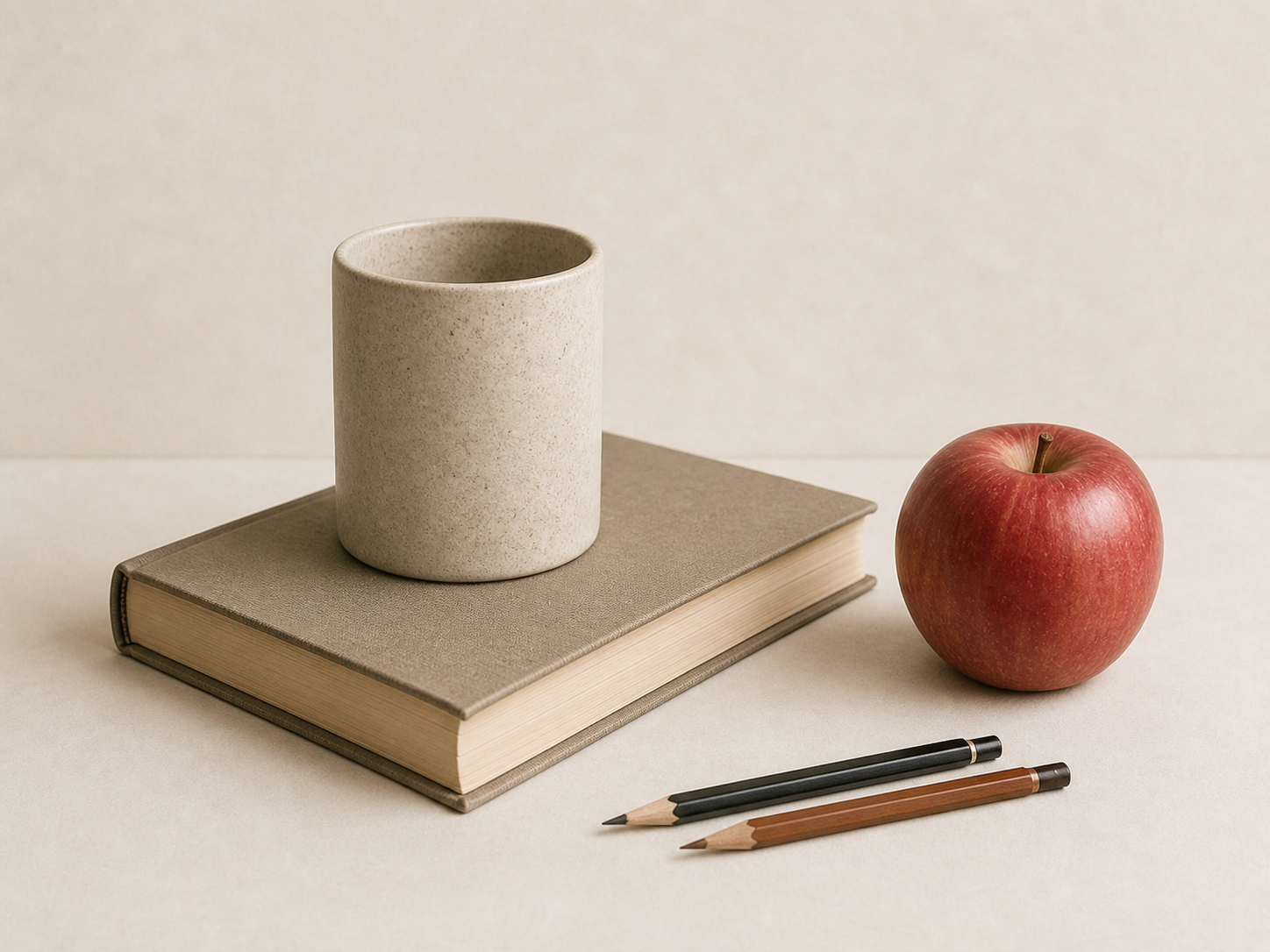
Still-life objects become easier to draw when they are understood as volumes in space. A cup behaves like a cylinder, a book like a box, and an apple like a sphere, even though their final contours are more irregular.
Construction drawing separates spatial logic from surface appearance. Light axes, ellipses, and directional edges create a framework that can later support contour variation, texture, and value.
A useful construction remains adjustable. Draw through hidden sides when that helps you understand the volume, compare the tilt of several axes, and check where one form overlaps another before strengthening the visible contour. Then translate the geometry back into the character of the actual object: a handmade mug may swell unevenly, a book cover may bend, and an apple may depart from a perfect sphere. The simple form is a spatial foundation, not a replacement for close observation. Keeping both layers in mind produces drawings that feel solid without becoming sterile diagrams. Rotate the arrangement between studies to test whether you understand the volumes rather than one memorized outline.
Identify the underlying volume
Name the simplest useful form before drawing the object’s local details. The goal is not to force every object into geometry, but to reveal how it occupies space.
Use axes to show direction
A center axis keeps cylinders and round objects coherent. It also helps related ellipses agree about tilt and degree.
Keep box edges in directional families
Edges that recede in the same direction should relate consistently. This makes books, tables, and containers feel solid rather than warped.
Common mistakes
Drawing ellipses as pointed footballs
Ellipses should turn smoothly through their widest points. Avoid sharp ends and mismatched top and bottom openings.
Treating every contour as equally important
Construction lines can remain light. Strengthen only the edges that clarify overlap, silhouette, or plane change.
Shading before the forms agree
Value cannot rescue inconsistent axes or perspective. Check the volumes first, then organize light.
Progress the skill
Move from ideal forms to observed variations
Arrange two objects based on the same underlying form, such as a straight factory-made mug and a handmade cup. Construct both as cylinders first, then compare exactly where each contour departs from the ideal volume. The exercise separates useful irregularity from accidental distortion and shows why construction should guide observation without replacing it.
Add a third object that overlaps the first two and draw through the hidden volumes lightly. Check whether every object sits on the same surface and whether its axis agrees with the opening and base. Only after the spatial arrangement works should you strengthen silhouette changes that describe material or character.
Practice exercise
Cylinder, box, sphere study
Arrange a mug, book, and piece of fruit under one light source.
- 01Mark the overall arrangement and object overlap.
- 02Construct the mug with an axis and related ellipses.
- 03Build the book as a box with consistent directional edges.
- 04Place the fruit as a sphere with a center direction.
- 05Add one broad shadow family without hiding the construction.
Frequently asked questions
Should construction lines be erased?
They can be lightened or partially erased, but keeping some visible during practice makes the spatial reasoning easier to review.
How accurate must perspective be in a small still life?
It should be internally consistent. You rarely need formal vanishing-point diagrams, but related edges and ellipses must agree.
Why use simple forms when real objects are irregular?
Simple forms provide a stable spatial base. Irregular contour changes become easier to place once the underlying volume is clear.